
Americans can’t fly to Cuba as tourists. That was true in 2018 when I went, and it’s still true now. There are twelve approved categories of travel — religious, educational, journalism — and the one we picked was Support for the Cuban People.
Which means: we couldn’t just go for fun. We had to actually do something useful while we were there.

So before any of us booked flights, we packed two duffel bags full of school supplies and feminine hygiene products to bring to a primary school in Havana. Pads and tampons in Cuba are wildly expensive when you can find them. School supplies — same.
I was going with three women I’d barely met. One I knew from a travel meetup in LA. She knew the others. We were all roughly the same age, all working women, all itching to go somewhere where our phones wouldn’t really work — and crucially, all willing to spend a Saturday at Target buying composition books for kids we’d never see again. Strangers becoming travel companions. The original premise of every great trip.
The trip at a glance — June 14–18, 2018 · 5 days · LAX ? ATL ? Havana · $350 round-trip · $300 Airbnb split between two · Travel category: Support for the Cuban People
The arrival
Havana heat hits different. Not LA-summer heat, not Florida-July heat. Havana heat is dense, salty, smells like diesel and old plaster. The Airbnb host met us at the door with a smile and zero English. We dropped our bags. We got back outside fast.
First stop, on every single Havana itinerary you’ll find online: La Guarida. It’s a paladar — a private, family-run restaurant — set inside a crumbling colonial building you walk three flights up to enter, past peeling walls and laundry strung on lines. The place was the set for Fresa y Chocolate in the ’90s. Rihanna shot her Vanity Fair cover here in 2015. It’s been named Best Restaurant in Cuba multiple times since. None of that prepared me for the food.

A few small plates, then up to Bar Mirador, their rooftop. Cuba at sunset, drinks in hand, four women who barely knew each other already laughing too loud. Our server pointed us toward La Fábrica de Arte Cubano — said no dress code, just go. So we went.

La Fábrica is a former cooking oil factory turned art club. There’s a gallery wing, a film room, a dance floor, a quiet lounge, all bleeding into each other so you keep accidentally walking from one vibe into another. We danced. We drank. We met a guy from Madrid and a couple from Toronto. By 1 a.m. I knew the three women I’d come with significantly better than I had at LAX.
Day 2 — The school, and then everything else
Breakfast at Café Arcángel. Toast, ham, scrambled eggs, OJ, Turkish coffee. Looked like an American hotel breakfast, tasted like nothing back home — in the best way.
Then the actual reason we were in Cuba.
Finding the school took longer than we thought. We had an address and a name we’d been given by someone who knew someone who knew the principal. Streets in Old Havana don’t always have signs. We asked, walked, asked again, finally found it.
I’m not going to describe the school. I didn’t take photos. We were there to drop off two duffel bags of supplies, not to make content. The principal accepted them politely, thanked us, and that was it. We left feeling — I don’t know how to put this exactly — useful but also small. Like, two duffel bags is what we did, and it mattered, and it also wasn’t very much.
The rest of the day was the trip we’d come for.

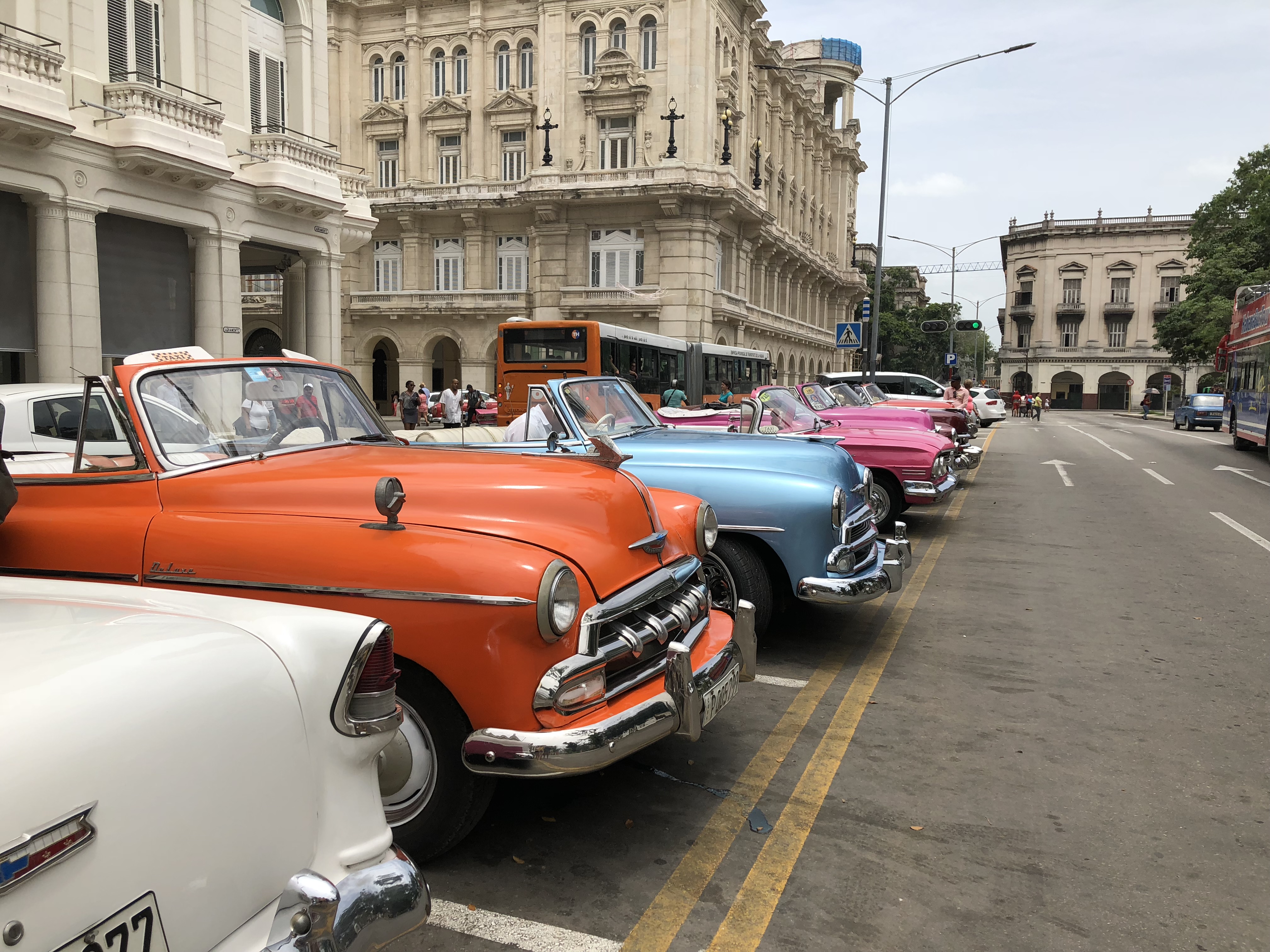
We stumbled into a parking lot full of vintage cars — the kind you’ve seen in every Cuba photo essay ever — and ended up in a conversation about tour options with the owner of Old Cars Havana. We booked their full ten-hour Viñales Valley tour for the next day on the spot. With the rest of the afternoon free, we hailed one of those vintage cars as a one-hour taxi.
Plaza de la Revolución first. The giant steel outline of Che Guevara on the Ministry of the Interior with Hasta La Victoria Siempre underneath — it’s an image you’ve seen on a thousand t-shirts, but standing under it does land differently than I expected.

Then El Floridita. Hemingway’s bar. Same Daiquiri recipe he drank: white rum, maraschino liqueur, lime, grapefruit, no sugar. There’s a life-size bronze of Hemingway propped at the bar like he’s about to order another. It’s touristy. You’ll pay touristy prices. You should still go.

We ended the day at Callejón de Hamel, an alley dedicated to Afro-Cuban culture, every wall covered in murals and sculpture. By the time we were heading back, two of our group had started feeling sick. We called it early.
Day 3 — Tobacco, caves, and red mud up to my knees
Ten hours. One vintage car. Four women who’d known each other for 48 hours and were already operating like a unit.

First stop: Finca Buena Vista, a tobacco farm in Rancho Alegre. The young guys running the farm spoke fluent English and walked us through everything — pesticide-free, fertilizer just the trimmings from previous harvests, drying houses lined floor to ceiling with leaves catching light from the windows. We rolled cigars (badly) under their patient supervision and walked out with the ones we’d made plus a few from the actual professionals.

Then horseback riding through Viñales Valley. Post-rainy-season Cuban red clay is a substance I now have personal opinions about. It is slick. It does not behave. The horse knows what it’s doing — you have to trust the horse. We made it through, muddier than we’d started, and tried fresh-pressed sugarcane juice mixed with rum at the farm. A combination I will be thinking about for the rest of my life.

Cueva del Indio next — a cave system you walk into and then float through on a small motorboat. Pre-Columbian cave paintings inside. The whole thing is lit just enough to make you feel like you’ve stepped into a movie set.
We finished at Mirador del Valle de Viñales, looking out over what locals call the Valley of Silence. It earns the name. No tractors, no engines — just wind and the distant clop of horses working the fields.
Day 4 — Bachata lessons and a Mexico–Germany match

Sunday morning at a local dance studio. Bachata first, salsa after. The instructors did a demo at the end of class that made the rest of us look like we’d never moved our hips before. (We had not.)
We found a tiny corner bar afterward, ordered Cubatas, and watched Mexico beat Germany at the 2018 World Cup. The bar was packed with locals and a handful of tourists, and the scream that went up when Lozano scored — I don’t know how to describe a sound like that to someone who wasn’t in the room. Everybody hugging everybody. Two strangers from Germany taking the loss gracefully. The bartender pouring rum from a bottle the size of his arm.
We went back to El Floridita afterward because by then it was tradition. Walked the callejones one more time. Tried not to think about leaving.
Day 5 — Havana ? JFK ? LAX

The flight home is just a flight home. What I want to say about Cuba is harder.
Coming back, I noticed things I’d never noticed before. Twelve types of cereal at the grocery store. Eggs available, every day, no discussion. Bottled water in pyramids at every gas station. Toilets that work without you thinking about them. I’m not going to do the dramatic “we have so much” speech because I think you can fill that one in yourself.
But I will say: the people I met in Havana were not waiting for me to feel sorry for them. They were running farms, teaching dance, rolling cigars, painting murals, raising kids, watching their team get knocked out at the World Cup with the same outrage as everyone else. The country is hard. The people are not asking for our pity. The supplies were just supplies — what they actually wanted was for someone to come and see and pay attention.
So that’s what I’m trying to do here. Pay attention. And tell you, in case you’re wondering whether to go:
Yes. Go. Bring something useful. Tip well.
More from this trip — photos in the Cuba camera roll ?
Leave a Reply